The Rings of Power’s New Rivendell Was Inspired by Tolkien’s Art. Sauron’s Tower Tells the Opposite Story.
Spoiler notice: Contains spoilers for The Rings of Power Season 2 and details disclosed in official Season 3 previews. No unaired Season 3 outcomes are presented as fact.
The Rings of Power's designers have revealed two contrasting approaches to Middle-earth. Season 3's Rivendell draws on Tolkien's own watercolor paintings, while Sauron's Barad-dûr was conceived around a volcanic forge and a fortress that projects control. The production choices give the series an argument about what its characters use power to build.
A new Amazon set report, published October 29, describes how the production recreated a young Rivendell using a watercolor painted by J.R.R. Tolkien and a digital survey of the Swiss valley associated with his imagination. Earlier reporting from Entertainment Weekly revealed an almost inverse approach to Sauron’s Barad-dûr: a volcanic fortress whose central workshop copies the one he took from Celebrimbor.
Neither detail is a plot twist. Together, though, they suggest that the series wants architecture to express two competing ideas of power.
Rivendell is not supposed to look finished
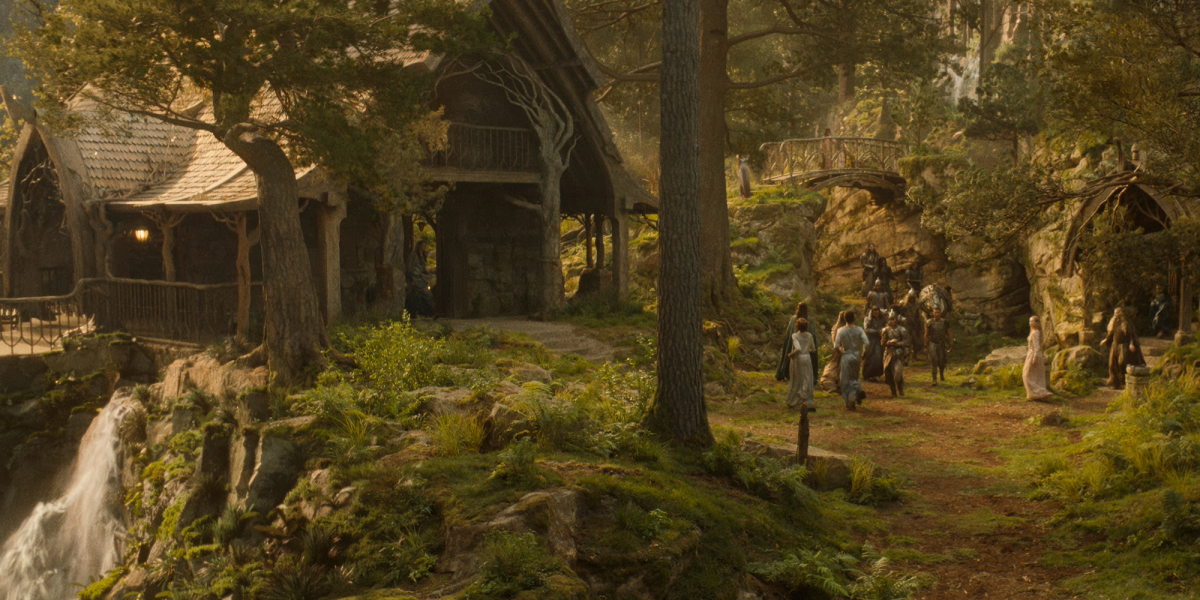
In Peter Jackson’s films, Rivendell feels as though it has existed forever. Its buildings and gardens are inseparable from the landscape, and the place carries the accumulated memory of an age. Season 3 of The Rings of Power is set much earlier, when Elrond’s sanctuary is still becoming itself.
Amazon’s October 29 behind-the-scenes feature explains that production designer Kristian Milsted and the showrunners wanted a version that looked established enough to offer refuge without pretending to be the mature Rivendell of the Third Age. The set at Shepperton Studios was constructed largely from wood, with living trees and plants. Stone was used sparingly, principally for the foundations of Elrond’s home.
That is a deliberate choice. A shelter built among living things should not feel like a structure that has conquered its surroundings. Its unfinished quality can also tell us something about Elrond. The character is not inheriting a palace; he is making a place where others might survive a catastrophe.
In Tolkien’s history, Imladris arises from the War of the Elves and Sauron after the destruction of Eregion. Its importance is therefore not simply geographical. It is an answer to displacement. The series has compressed and rearranged elements of the Second Age, so readers should not expect a scene-for-scene reconstruction of Tolkien’s chronology. But a refuge created in the shadow of war is very much at the heart of the original idea.
The production went back to Tolkien’s own pictures
The most revealing part of Amazon’s report is the reference point the team chose. Rather than reproduce Jackson’s designs, the artists studied a watercolor Tolkien made of Rivendell for The Hobbit. They also surveyed Switzerland’s Lauterbrunnen Valley, which Tolkien visited in 1911 and which has long been associated with his vision of the landscape.
Milsted said a visual-effects team scanned the valley from a helicopter, then used the digital terrain as the environment surrounding the physical set. That combination of a real stage, living plants and a mapped landscape is a practical filmmaking solution. It is also an unusually direct way of treating Tolkien as a visual artist, not only a novelist whose words can be converted into production designs.
Tolkien’s paintings have their own proportions and atmosphere. They are not photographs of a fully documented fictional world. A screen adaptation has to make choices where the original artwork leaves space for imagination. Using the paintings as a starting point does not automatically settle questions about fidelity elsewhere in the series. It does, however, give this particular location a clear artistic ancestry.
Barad-dûr is built to possess, not protect
Entertainment Weekly’s October 13 interview with Milsted describes a radically different design brief for Barad-dûr. The tower stands close to Mount Doom in the series, with a forge conceived around the idea of drawing on volcanic heat. Its walls evoke cast rock and stone; its silhouette takes cues from Sauron’s crown.
Most tellingly, Sauron’s forge reproduces the form of Celebrimbor’s workshop in Eregion. The production designer connected that decision to Tolkien’s recurring idea that evil distorts or imitates what already exists rather than originating life in the same way as the Creator.
Tolkien did not suggest that villains are incapable of making objects or devising sophisticated technologies. Sauron is, after all, a formidable maker. The deeper distinction concerns what making is for: stewardship, preservation and the freedom of other beings, or possession and the bending of others to a single will.
The set turns that distinction into something visible. According to EW, Celebrimbor’s body hangs in Sauron’s study, and the throne incorporates the remains of Elven armor taken after Eregion’s fall. These are details from advance production coverage, not scenes we have independently reviewed. But the design logic is unmistakable: the enemy’s craft, the enemy’s dead and the enemy’s defeated soldiers are converted into instruments of Sauron’s authority.
Rivendell receives the displaced. Barad-dûr displays the conquered.
Two kinds of world-building — and a test for the series
Rivendell and Barad-dûr both take extraordinary work to create, and both reflect the ambitions of their founders. One is being built as a place of refuge; the other expresses Sauron's determination to command those around him. Their architecture makes that difference visible before the characters explain it.
The production has an opportunity to make that difference legible without turning every conversation into a speech about good and evil. A room designed for counsel can tell us about Elrond before he gives advice. A workshop that repeats the architecture of a murdered craftsman can tell us about Sauron before he explains his ambitions.
This is also where visual fidelity and dramatic fidelity meet. Recognizable landscapes and references to Tolkien’s artwork can satisfy a viewer’s eye. They cannot, by themselves, make an adaptation feel like Tolkien. The harder task is to give those places the moral and emotional functions they hold in the legendarium.
Rivendell must be more than a picturesque destination. Barad-dûr must be more than a spectacular villain’s headquarters. If the spaces change the choices available to the characters, the production design will have become part of the storytelling.
Why the design matters to the story
The premiere calendar is covered in our Season 3 release schedule. Amazon’s synopsis places the story five years after the fall of Eregion, with Sauron seeking to forge the One Ring as the surviving realms resist his advance.
The new set reports tell us how the world was built and what its designers intended. They do not prove that the finished episodes will deliver on those intentions. That judgment can wait until the season airs.
Rivendell is being imagined as a refuge that can grow. Barad-dûr is a fortress designed around Sauron's need to dominate. If the drama makes those ideas matter to the people living inside the sets, the architecture will carry part of Tolkien's conflict without a speech.
Sources
Amazon's on-set report on Rivendell contains the design team's own explanation of the location's new look.
Entertainment Weekly: production designer Kristian Milsted on Barad-dur.


Join the conversation
Share your thoughts on this story. Please keep the discussion thoughtful and respectful.